Edit configuration
hal0’s configuration lives as plain TOML (plus one env file) under
/etc/hal0. The directory is preserved across updates — the
updater only swaps code, never your config. The hal0 config CLI is a
thin layer over the same files and the running daemon.
The files under /etc/hal0
Section titled “The files under /etc/hal0”| File | What it holds |
|---|---|
hal0.toml | Top-level config: [meta] schema_version, [slots] (port range, idle_timeout_s, evict_pressure_mb, publish_host), [dispatcher] prefetch tuning, [models] roots/store, [memory] engine + [memory.graph] extraction, [activity] audit-log retention, [telemetry] channel. |
api.env | Environment for the hal0-api service (systemd EnvironmentFile) — provider secrets plus env knobs like HAL0_MODEL_STORE, HAL0_MCP_ALLOWED_HOSTS, and the HAL0_*_PUBLIC_URL reverse-proxy overrides. |
upstreams.toml | External / upstream provider routing. |
providers.toml | Provider credential references (key names, never plaintext secrets). |
profiles.toml | Optional custom profile catalogue. The built-in seed profiles (rocm, rocm-moe, vulkan, cuda, embed, rerank, flm, tts, tts-qwen3, cpu-llm, comfyui, …) are always overlaid from code on load and are never written back here, even if the file exists. |
capabilities.toml | Persisted capability selections (embed / voice / img / vision). Carries its own schema_version. |
slots/<name>.toml | One file per slot — name, port, device (gpu-rocm|gpu-vulkan|gpu-cuda|cpu|npu), gpu_index (multi-GPU pinning), profile, mtp (tri-state Auto/on/off), vision (mmproj toggle), the TTS request-default trio (default_voice/default_speed/default_response_format), plus nested [model], [server], [npu] (asr/embed), and — on the img slot only — [image]. |
Other files the runtime drops here: hardware.json (cached hardware
probe), manifest.json (release image pins), openwebui.env.
Show the current config
Section titled “Show the current config”hal0 config showPrints hal0.toml as it is on disk. If the file is root-owned and you run
as a non-root user, the command tells you to re-run with sudo (or to
chmod the config tree once) instead of crashing.
Edit the config
Section titled “Edit the config”hal0 config editOpens hal0.toml in $EDITOR (falling back to $VISUAL, then vi). If
the file doesn’t exist yet, it’s created with a valid skeleton
([meta] schema_version, [slots] port range).
Validate before you reload
Section titled “Validate before you reload”hal0 config validateLoads and validates hal0.toml, upstreams.toml, and providers.toml
against the current Pydantic schema. It prints each problem and exits
non-zero on any failure, or ✓ All configs pass schema validation. when
clean.
Reload a running daemon
Section titled “Reload a running daemon”After editing, ask the live daemon to re-read its TOMLs without a full restart:
hal0 config reloadThis hits POST /api/settings/reload on the local API. If the daemon is
down, the command exits non-zero — start hal0-api first.
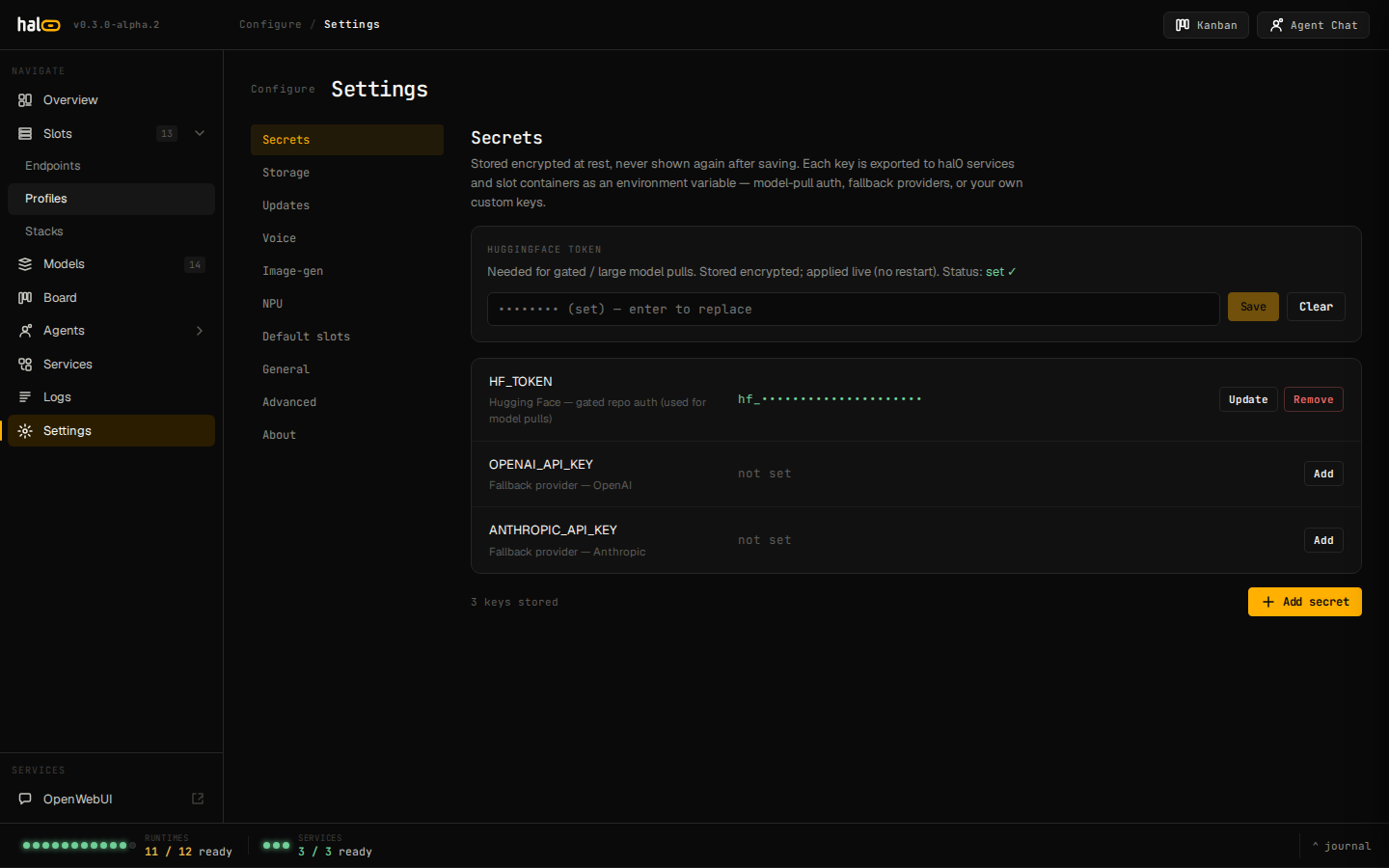 Settings page with live daemon status and reload controls.
The dashboard’s Settings → Storage section also has its own Reload
from disk button next to the hal0.toml path, which hits this same
POST /api/settings/reload — use it after an out-of-band edit with hal0 config edit.
The dashboard Settings page
Section titled “The dashboard Settings page”Beyond the files and CLI above, the dashboard’s Settings view covers most of the same ground with a few operator conveniences. Sections, in nav order: Secrets, Storage, Updates, Voice, Image-gen, NPU, Default slots, General, Advanced, About.
- Secrets — provider API key presets (Hugging Face, OpenAI, Anthropic,
Google, Groq) plus two paired AWS Bedrock presets
(
AWS_ACCESS_KEY_IDandAWS_SECRET_ACCESS_KEY, cross-referenced in the picker so you’re reminded to set both), or a custom key name. - Voice — STT enable + model, and the TTS request-default trio for
the serving
ttsslot: Default voice (populated from the live voice list where available), Default speed (0.25–4.0), and Default format (mp3/wav/opus/flac/pcm). These persist to the same[slot]keys asslots/<name>.tomland are applied to the next/v1/audio/speechrequest with no restart — see Voice (STT/TTS). - Image-gen —
default_size,default_steps, andidle_restore_minutesfor theimg/ComfyUI slot’s[image]table.idle_restore_minutes(how long ComfyUI can sit idle before the GPU arbiter restores LLM slots) is hot-reloadable — it takes effect on Save with nohal0-apirestart. - NPU — for FastFlowLM (FLM) slots: Context size (
--ctx-len), Load embeddings, and Load ASR (all require restarting the slot), plus a read-only Occupancy panel (TOPS, tile usage, per-slot breakdown) when an NPU is present. - Advanced — schema-driven controls for every
[slots],[dispatcher],[memory], and[activity]key that previously requiredhal0 config edit(includingslots.evict_pressure_mb, the pressure-eviction floor; thememory.enginepicker only offershindsight/pgvectoreven though the schema also acceptscognee/mem0, since those two are silently remapped to hindsight), plus a dedicated memory graph panel for[memory.graph](extraction_slot,llm_timeout_s) and a Restart hal0-api button — a one-click restart-and-health-poll forhal0-api.service, handy after any change flagged “restart required”. - General — the Anonymous telemetry opt-in toggle for
[telemetry] enabled(off by default; see Configuration schema reference).
Migrate the schema forward
Section titled “Migrate the schema forward”When you update hal0 across a schema bump, bring hal0.toml to the latest
version:
hal0 config migrateIt reads meta.schema_version, runs the registered migration chain, and
atomically writes the result back only if the version actually
advanced. If the config is already current (or absent), nothing is
written and that is reported honestly.
Atomic writes
Section titled “Atomic writes”Every config write hal0 performs — config migrate, the settings API,
the updater’s hal0.previous record — uses a tempfile + os.replace
pattern so a write is either fully applied or not at all; an interrupted
write never leaves a half-written, unparseable file in place.
See also
Section titled “See also”- Configuration schema reference — every key in
hal0.tomland the per-slot files. - Paths and files — the full FHS map.
- Environment variables — the
api.envkeys. - Update and roll back — how updates preserve
/etc/hal0. - Voice (STT/TTS) — the TTS request-default trio in depth.