Devices, providers & profiles
A hal0 slot is described by three orthogonal facts: a device (the hardware preference), a provider (the inference runtime label), and a profile (a reusable container template — image plus bench-tuned flags). This page is the authoritative reference for the valid values of each and how they connect.
Devices
Section titled “Devices”device carries hardware intent only. It is validated at config-load time —
a typo raises a ValidationError with the field path.
device | Hardware | Default provider |
|---|---|---|
gpu-rocm | AMD GPU via ROCm | llama-server |
gpu-vulkan | Any GPU via Vulkan | llama-server |
gpu-cuda | NVIDIA GPU via CUDA — experimental | llama-server |
cpu | CPU-only fallback | llama-server |
npu | AMD XDNA NPU via FastFlowLM | flm |
gpu-rocm is the package-level default device constant, but the hardware
recommender actively steers Strix Halo (unified memory) installs to gpu-vulkan
for broader compatibility. On an NVIDIA host the recommender picks gpu-cuda
when nvidia-container-toolkit (CDI) is present, and falls back to
gpu-vulkan otherwise. The recommender may also select cpu or npu on
hosts without ROCm support.
Multi-GPU hosts
Section titled “Multi-GPU hosts”hal0’s hardware probe enumerates every detected GPU (index + PCI bus id),
additively for both AMD and NVIDIA parts. A slot can pin to one GPU via the
gpu_index field, which emits the backend-appropriate visibility mechanism:
HIP_VISIBLE_DEVICES + ROCR_VISIBLE_DEVICES for gpu-rocm,
GGML_VK_VISIBLE_DEVICES for gpu-vulkan, or a CDI nvidia.com/gpu=<n>
device plus CUDA_VISIBLE_DEVICES=0 inside the container for gpu-cuda. An
explicit [server].env entry always wins over the derived visibility var.
Leaving gpu_index unset (the default) exposes all GPUs — unchanged
behaviour.
Providers
Section titled “Providers”provider is the runtime label round-tripped on each slot. Every slot runs as
a podman container regardless of provider; the field exists for UI labels and
backwards compatibility.
provider | Runtime | Typical slot types |
|---|---|---|
llama-server | llama.cpp server (ROCm / Vulkan / CUDA / CPU) | chat, embed, rerank |
flm | FastFlowLM on the NPU | chat / stt / embed (one process, trio) |
kokoro | Kokoro-82M text-to-speech (ONNX, CPU) | tts |
qwen3tts | Qwen3-TTS-12Hz-1.7B multilingual TTS (ROCm, GPU) | tts |
comfyui | ComfyUI image generation | image |
Seed profiles
Section titled “Seed profiles”Profiles live in /etc/hal0/profiles.toml. When that file is absent, hal0
serves the built-in seed catalog below, so GET /api/profiles is always
populated on a fresh install. A profile supplies the container image, the
bench-tuned flag bundle, and an optional MTP toggle; the slot supplies the
model, context size, and port.
| Profile | device_class | Image | MTP | Intent |
|---|---|---|---|---|
rocm | gpu | ghcr.io/hal0ai/amd-strix-halo-toolboxes:rocm-7.2.4-rocmfp4-server | off | MoE agents · q8 KV |
rocm-dnse | gpu | ghcr.io/hal0ai/amd-strix-halo-toolboxes:rocm-7.2.4-rocmfp4-server | on | Dense + MTP · q8 KV |
rocm-moe | gpu | ghcr.io/hal0ai/amd-strix-halo-toolboxes:rocm-7.2.4-rocmfp4-server | on | MoE + MTP · q8 KV |
vulkan | gpu | ghcr.io/hal0ai/amd-strix-halo-toolboxes:vulkan-radv-server | off | Vulkan std · fallback |
cuda | gpu | ghcr.io/ggml-org/llama.cpp:server-cuda | off | CUDA · NVIDIA (upstream llama.cpp, experimental) |
embed | gpu | ghcr.io/hal0ai/amd-strix-halo-toolboxes:rocm-7.2.4-rocmfp4-server | off | Embeddings · GPU |
rerank | gpu | ghcr.io/hal0ai/amd-strix-halo-toolboxes:rocm-7.2.4-rocmfp4-server | off | Reranking · GPU |
tts-qwen3 | gpu | ghcr.io/hal0ai/hal0-toolbox-qwen3tts:v1 | off | TTS · Qwen3 (multilingual GPU) |
flm | npu | ghcr.io/hal0ai/hal0-toolbox-flm:0.9.43 | off | FLM NPU inference |
tts | cpu | ghcr.io/hal0ai/hal0-toolbox-kokoro:v1 | off | TTS · Kokoro |
cpu-llm | cpu | ghcr.io/hal0ai/amd-strix-halo-toolboxes:vulkan-radv-server (no GPU passthrough) | off | CPU-only LLM · llama-server |
comfyui | img | docker.io/kyuz0/amd-strix-halo-comfyui@sha256:0066678ae9043f69… | off | Image generation |
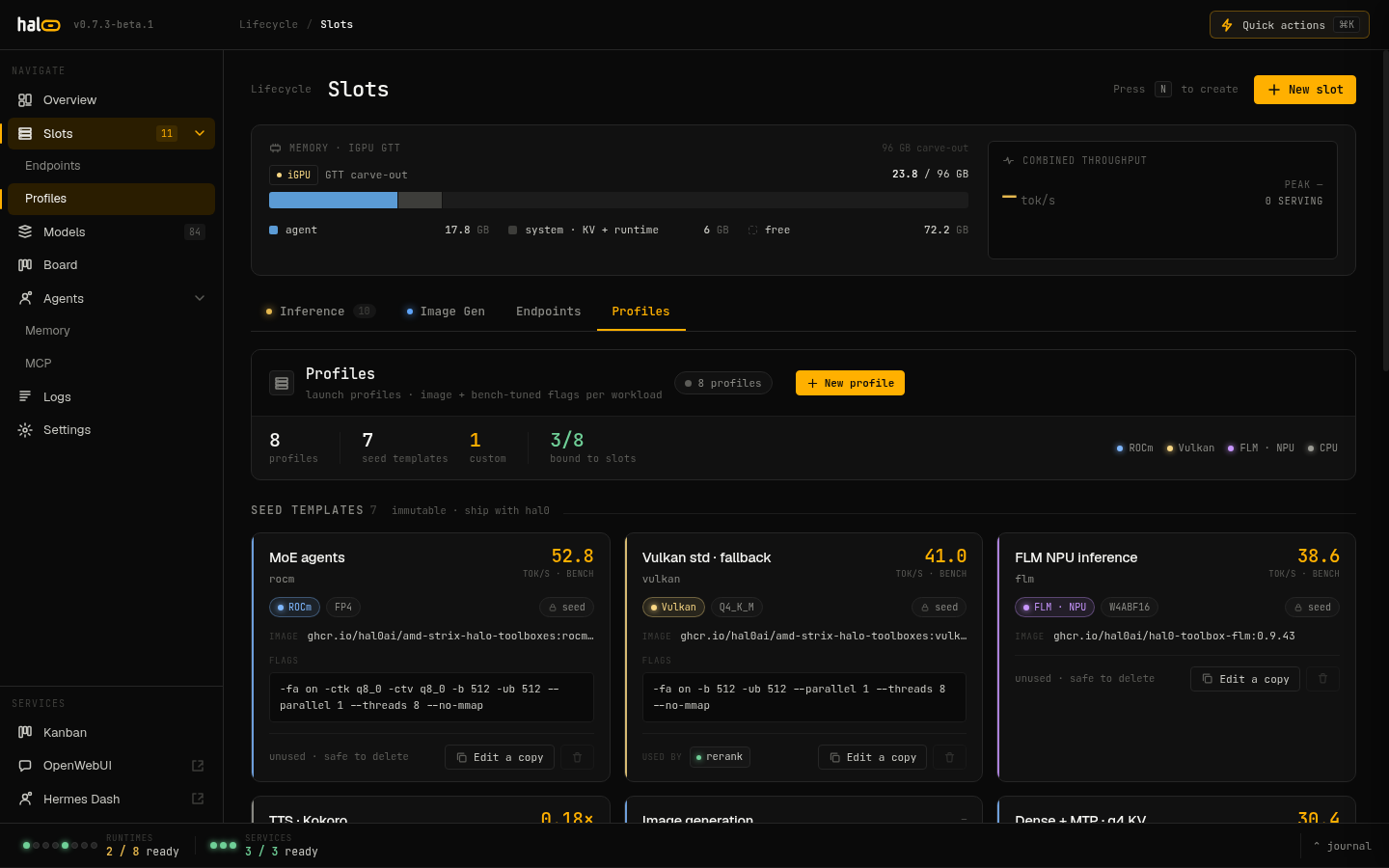 Profiles tab in the hal0 dashboard — seed profile cards display device class, quantisation, and bench throughput (tokens/sec or RTF).
The embed and rerank profiles bake in the llama-server serving flags
(--embedding / --reranking, -ub 8192 so a full input fits one physical
batch) so an embedding or reranking slot no longer has to hand-wire them in
extra_args. On a gpu-rocm box, embed/rerank slots derive onto these lanes
automatically; a Vulkan or CPU box falls back to the vulkan / cpu-llm
profile until backend-specific embed/rerank variants ship.
MTP flag bundle
Section titled “MTP flag bundle”A slot’s mtp field is a tri-state: true forces MTP on, false forces it
off, and unset (Auto) defers to the profile. Under Auto, MTP is effective
only when both the profile opts in (mtp = true — only rocm-dnse and
rocm-moe do among the seeds) and the model is MTP-eligible (a registry
mtp tag, or an mtp marker in the model’s id/filename). A profile opting in
no longer means “always append the spec-draft bundle” — a non-MTP model
sitting on rocm-moe under Auto launches clean, without dead
--spec-draft-* flags. See Capabilities and
profiles
for the full model/profile/slot resolution.
Whenever the effective setting is on, resolve_profile_flags merges the
multi-token-prediction draft-speculation flag bundle (MTP_FLAG_BUNDLE) into
the profile’s flags — as defaults only. A profile’s own explicit
--spec-draft-* flags win; the bundle just fills in whatever the profile left
unset. Before v0.8.2b2 (#963) the bundle was appended verbatim and silently
clobbered a profile’s pinned spec-draft flags (e.g. a profile asking for
--spec-draft-type-k f16 still launched with the bundle’s q8_0) — that’s
fixed now. The bundle’s draft device also tracks the profile’s own backend
(ROCm0 / Vulkan0 / CUDA0) instead of a hardcoded ROCm0.
Device-to-default-profile map
Section titled “Device-to-default-profile map”The create-slot device picker and legacy-slot migration use this map to choose a starting profile per device class:
device | Default profile |
|---|---|
gpu-rocm | rocm |
gpu-vulkan | vulkan |
gpu-cuda | cuda |
cpu | cpu-llm |
npu | flm |
Model preferred profile
Section titled “Model preferred profile”A registry model can also carry a preferred profile via defaults.profile. A
slot adopts it on create (when the slot has no explicit profile) and on
every model swap — but only when the profile fits the slot: it must exist
in the catalog, support the slot’s type, and match the slot’s
device_class/backend. An incompatible preference is skipped (logged as
slot.preferred_profile_skipped) and the slot keeps its current or
device-default profile; hal0 never flips a slot’s device to satisfy a model’s
preference.
Portable profiles: export/import
Section titled “Portable profiles: export/import”A profile can be exported to a self-contained, checksummed
.hal0profile.json envelope and imported on another host — the same sharing
model stacks use (no secrets, no host paths, an
independent schema_version).
GET /api/profiles/{name}— resolve a single profile.POST /api/profiles/{name}/export— build the envelope:{kind: "hal0.profile", schema_version, hal0_version, exported_at, name, checksum, profile}.checksumis a sha256 over the canonical profile body only (key-order independent), so re-exporting an unchanged profile yields the same checksum every time.POST /api/profiles/import— dry-run then commit.{"envelope": {...}, "name": "...", "dry_run": true}validates the envelope + checksum and reports whethernamecollides with an existing profile, without creating anything. A commit (dry_runfalse,nameset) creates the profile and returns409 profiles.existson a name collision.
MCP mirrors the same surface: profile_list / profile_status /
profile_export are read-shaped (autonomous, no confirmation gate);
profile_import / profile_delete are gated. The dashboard’s Profiles tab
has an Export button on every profile card and an Import dialog
(file → dry-run → commit) in the tab header.
Toolbox images
Section titled “Toolbox images”Toolbox images are pinned per hal0 release in manifest.json (by short name →
canonical ref plus a sha256 digest). They are public on ghcr.io/hal0ai/; the
installer pulls them anonymously. An empty digest means the image is unpublished
for that release and the runtime pulls by tag with a warning.
| Short name | Image ref (current release) | Notes |
|---|---|---|
vulkan | ghcr.io/hal0ai/amd-strix-halo-toolboxes:vulkan-radv-server | llama.cpp Vulkan backend |
rocm | ghcr.io/hal0ai/amd-strix-halo-toolboxes:rocm-7.2.4-rocmfp4-server | llama.cpp ROCm backend |
flm | ghcr.io/hal0ai/hal0-toolbox-flm:0.9.43 | FastFlowLM on AMD XDNA2 NPU |
kokoro | ghcr.io/hal0ai/hal0-toolbox-kokoro:v1 | Kokoro-82M TTS (CPU ONNX) |
qwen3tts | ghcr.io/hal0ai/hal0-toolbox-qwen3tts:v1 | Qwen3-TTS-12Hz-1.7B multilingual TTS (ROCm) |
comfyui | docker.io/kyuz0/amd-strix-halo-comfyui@sha256:0066678ae9043f69a1c8c7699e70626ceffd35c1a8ca03227a05640ad0241ed2 | ComfyUI image generation |
See also
Section titled “See also”- Hardware matrix — what runs on each device and the backend availability order.
- Config schema — the full slot TOML, profile, and
hal0.tomlfield reference. - Paths & files — where
profiles.toml, slot TOMLs, andmanifest.jsonlive.