Companion services
hal0 sits next to a handful of companion services — a chat UI, an image-gen
engine, a bundled agent, a memory engine — each with its own systemd unit,
port, and health story. The companion-service management layer gives
these one declarative registry, one API surface, and one dashboard page,
instead of the ad-hoc systemctl calls and per-feature status cards each
service used to grow independently.
The registry
Section titled “The registry”Every companion service is one entry in a declarative catalog
(hal0.services.registry). Each entry carries: the owning systemd unit (or
None for an unmanaged/external service), the LAN port for a host:port URL
fallback, an env var for an operator-declared public URL, a probe strategy,
the lifecycle verbs the API is allowed to run, and whether the service is
advertised over mDNS.
The current catalog:
| Service | Unit | Port | Actions | Notes |
|---|---|---|---|---|
| OpenWebUI | hal0-openwebui.service | :3001 (LAN) | start/stop/restart/enable/disable | Podman container; HTTP-probed at /health. |
| ComfyUI | hal0-slot@img.service | :8188 (LAN) | restart only | Start/stop is GPU-arbiter managed — the img slot unit owns the switchover logic, so only restart is exposed (the same verb the FirstRun repair button uses). |
| Hermes | hal0-agent@hermes.service | :9119 (loopback only) | start/stop/restart/enable/disable | Bundled agent + dashboard. No LAN URL fallback — a link is shown only when HAL0_HERMES_PUBLIC_URL is set. |
| Hindsight | hindsight-api.service | :9177 (loopback only) | start/stop/restart/enable/disable | Native memory-engine daemon. Same no-fallback-URL rule as Hermes. |
| n8n | (none — external) | — | read-only | Workflow automation the operator runs themselves; hal0 does not deploy it. Listed with URL/probe env hooks but carries no lifecycle actions until a unit exists. |
Every lifecycle verb (start, stop, restart, enable, disable) is
enforced twice: once against the per-service allow-list in the registry, and
again at the execution boundary in hal0.services.systemd — a crafted
request can never reach an arbitrary systemctl verb, and a service like
ComfyUI can never be stopped or started through this surface even if the
route is called directly.
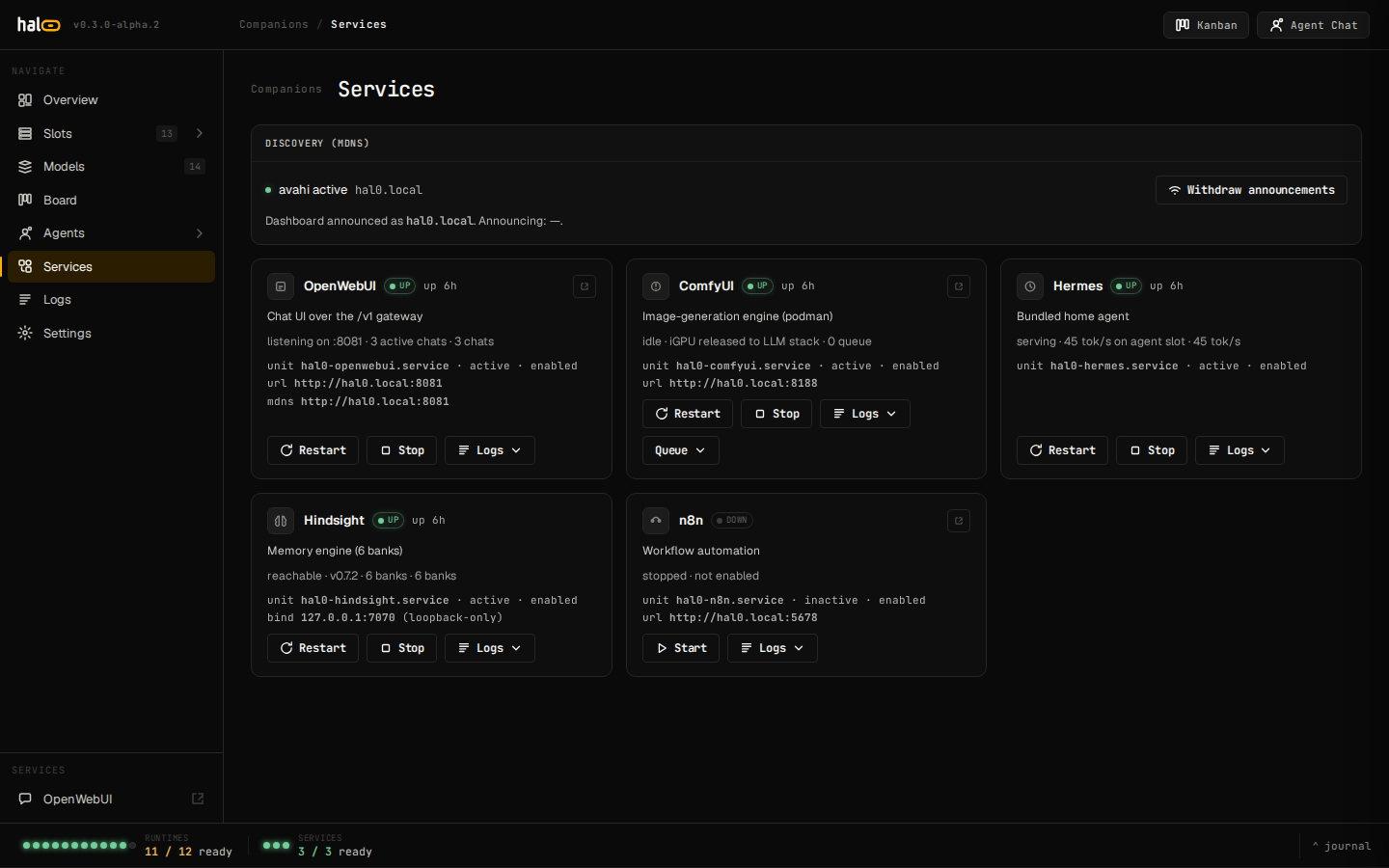
Dashboard: Services page
Section titled “Dashboard: Services page”The dashboard has a top-level Services nav item (hash route #services)
showing:
- A discovery (mDNS) card with an announce/withdraw toggle for addon advertisement.
- One card per registered service: status pill, systemd uptime, unit
metadata, an “open” button for the browser-facing URL, registry-driven
lifecycle buttons (a
stopaction asks for confirmation first), a journald logs drawer (reusingGET /api/logs?unit=), and — for ComfyUI — the shared live-queue drawer.
Every probe is fail-soft: a probe or systemd failure degrades to an honest
“unknown”/down state, never a fabricated “up” and never a 500. Older
backends without this surface show “source pending” rather than breaking the
page.
mDNS discovery
Section titled “mDNS discovery”hal0’s installer already advertises the main dashboard as hal0.service
under /etc/avahi/services. The companion-service layer extends that with
one addon announcement per advertised service:
hal0-addon-<id>.service, so LAN clients see distinct entries like
“OpenWebUI on <host>” / “ComfyUI on <host>” and can reach each one at
http://<host>.local:<port> without DNS.
Key properties:
- Only services with
mdns=Truein the registry and a LAN port are advertisable — that’s OpenWebUI and ComfyUI today. Loopback-only services (Hermes, Hindsight) and the external n8n entry are never advertised. - Advertising writes an avahi service-group XML file per service;
withdrawing removes every
hal0-addon-*file. avahi-daemon inotify-watches the directory, so changes take effect immediately — no daemon reload, nosystemctlcall. - The installer-owned
hal0.servicefile is never touched by this layer. availablein the discovery status reflects whetheravahi-daemon.serviceis actually active — not a guess from binary presence.HAL0_HOSTNAME(set by the install wizard) wins over the raw system hostname when deriving the.localname shown to operators.
The /api/services surface
Section titled “The /api/services surface”| Method & path | Purpose |
|---|---|
GET /api/services | Full per-service detail: probe state, systemd unit state + uptime, browser URL, mDNS URL, and the permitted actions list. Never 500s — every probe/systemd failure degrades to an honest unknown. |
POST /api/services/{id}/action | Run one lifecycle verb (start/stop/restart/enable/disable) against a service’s unit. Body: {"action": "..."}. Rejected with 400 services.action_not_allowed if the verb isn’t in that service’s allow-list, or 404 services.unknown for an unrecognized id. Audit-logged via the shared action-recording facility. |
GET /api/services/mdns | avahi/mDNS discovery status (available, hostname, advertised) plus the list of advertisable services. |
POST /api/services/mdns | Advertise ({"advertise": true}) or withdraw ({"advertise": false}) the addon mDNS announcements. Audit-logged. |
This is the richer sibling of the pre-existing GET /api/services/health
aggregator, which keeps its own stable read-only contract for the dashboard
Overview card — the two share probe implementations under the hood, so
health numbers stay consistent between the Overview card and the dedicated
Services page.
Per-service logs reuse the existing generic journald surface
(GET /api/logs?unit=<unit>) — each entry in GET /api/services carries its
unit name so the UI can wire a logs drawer without a dedicated endpoint.
See also
Section titled “See also”- REST API index — the full
/api/*router index, including/api/servicesand/api/services/health. - Authentication & HTTPS — mDNS/
.localaddressing for the main dashboard, which this page’s addon advertisements build on.